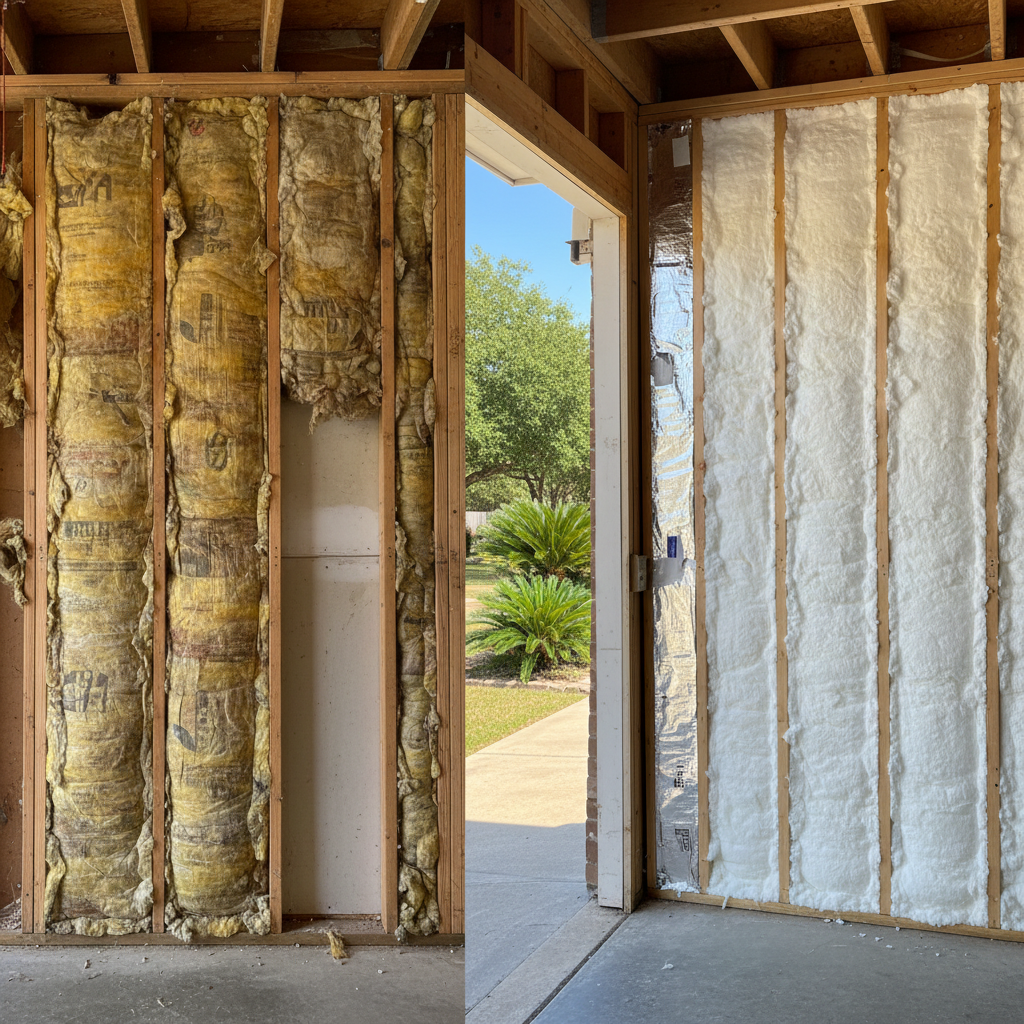
Alright, let's talk about that garage of yours. If you live anywhere around Seguin, especially during July and August, you know that space can turn into an oven. People often ask me about the best way to insulate it, and usually, it boils down to two main contenders: spray foam and radiant barriers. Both have their place, but for a garage, especially here in Texas, one usually pulls ahead.
What's a Radiant Barrier, Anyway?
A radiant barrier is basically a reflective material, usually a thin sheet of aluminum foil, that you install in your attic or, in this case, your garage ceiling. Its job is to reflect radiant heat energy. Think of it like a space blanket for your house. The sun beats down on your roof, heats up the shingles, then the roof decking, and that heat radiates down into your attic or garage. A radiant barrier tries to bounce a lot of that heat back up before it can really get into your living space.
They're pretty straightforward to install, especially if you've got an accessible attic. You can staple them to the underside of the roof rafters or lay them over existing insulation. They don't really add much R-value (that's the measure of thermal resistance), but they're good at stopping radiant heat transfer.
Then There's Spray Foam Insulation
Now, spray foam is a whole different beast. This stuff is a liquid that gets sprayed onto surfaces – usually the underside of your roof deck or the walls – and then expands into a solid, insulating layer. You've got two main types: open-cell and closed-cell. Open-cell is softer, more flexible, and lets moisture pass through. Closed-cell is denser, more rigid, and creates a vapor barrier, which is a big deal in our humid climate.
When we spray foam a garage, we're usually aiming for the roof deck. This creates an unvented attic or, in your garage's case, an unvented ceiling assembly. It seals up all those tiny cracks and gaps where air can sneak in, creating a much tighter, more consistent thermal envelope. It's not just blocking heat; it's stopping air movement, too.
Cost: Upfront Investment
Let's be real, cost is always a factor. Generally, a radiant barrier is going to be less expensive upfront. It's a simpler material and often quicker to install. You might pay a few hundred to a couple of thousand dollars, depending on the size of your garage and whether you DIY or hire a pro.
Spray foam, on the other hand, is a bigger investment. It requires specialized equipment and trained technicians to apply it correctly. You're looking at several thousand dollars, sometimes more, for a professional spray foam job in a garage. It's not a cheap fix, that's for sure.
Durability and Maintenance
Both options are pretty durable once they're in. A radiant barrier isn't going to degrade unless it gets physically damaged or covered in dust, which can reduce its effectiveness over time. You might need to clean it off every now and then if it gets really dusty, but generally, it's set it and forget it.
Spray foam is incredibly durable. Once it cures, it's there for the long haul – basically the life of your home. It won't settle, sag, or degrade. Pests don't like it, and it doesn't support mold growth. There's virtually no maintenance required.
Appearance Matters, Sometimes
In a garage, appearance might not be your top priority, but it's worth a mention. A radiant barrier, especially if it's just stapled to the rafters, can look a bit utilitarian. It's shiny silver. If you're going for a finished look, you'd probably want to cover it with drywall.
Spray foam, when applied well, creates a clean, monolithic surface. It's usually an off-white or yellowish color. Many folks leave it exposed in their garage, especially if they're not planning to drywall the ceiling. It looks much tidier than exposed fiberglass batts or a crinkled radiant barrier.
Performance in Texas Heat: My Honest Take
Okay, this is where the rubber meets the road, especially for us here in Seguin. We deal with serious heat and humidity. That 100-degree summer day, combined with high humidity, makes everything feel worse.
A radiant barrier will help. It'll definitely reduce the radiant heat coming into your garage. You'll notice a difference compared to having nothing at all. If your garage is already well-sealed and you just want to knock down some of that radiant heat, it's a decent option.
But here's the thing: a radiant barrier doesn't seal air leaks. It doesn't stop convection (heat transfer through air movement) or conduction (heat transfer through materials). And air leaks are a huge problem in most garages. Hot, humid air finds every little crack and gap – around doors, windows, utility penetrations, you name it – and just pours in.
Spray foam does it all. When applied to the roof deck and walls, it creates an incredibly effective air seal. It stops radiant heat, conduction, and convection. It essentially brings the temperature of your garage closer to the outdoor ambient temperature, but without the direct sun beating down. More importantly, it dramatically reduces the amount of hot, humid air infiltrating the space. This is critical for comfort and for keeping moisture out, especially if you've got a workshop or store sensitive items in there.
I've seen garages in neighborhoods like Pecan Bottom that were just unbearable, and after a good spray foam job, they're usable year-round. You can actually work out there, or do projects, without feeling like you're melting.
My Recommendation for Seguin Homeowners
For a garage in Seguin, TX, if your budget allows, I'm going to lean towards spray foam insulation every single time. Yes, it's more expensive upfront. I get that. But the performance difference, especially in our climate, is night and day. You're not just reducing heat; you're creating a truly conditioned space that's sealed against air and moisture. It's a holistic solution.
If spray foam isn't in the cards right now, a radiant barrier is a good step up from nothing. It'll offer some relief. But if you want to make your garage genuinely comfortable and energy-efficient for the long haul, especially if you're planning to spend any real time in there, spray foam is the clear winner.
Give us a call at Champion Insulation Company if you want to talk specifics for your garage. We're happy to come out and give you an honest assessment.